
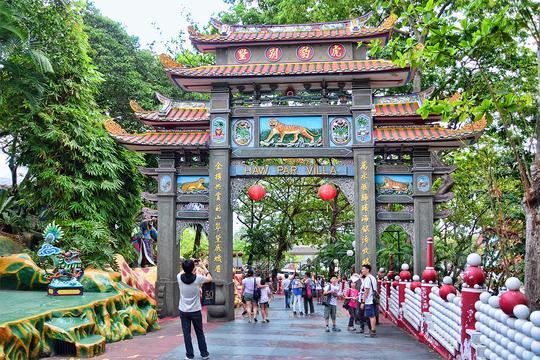
Exploring the Ten Courts of Hell at Haw Par Villa, Singapore: A Journey Into the Afterlife
Singapore is famous for futuristic skyscrapers, luxury shopping malls, beautiful gardens, and world-class food. But hidden among all this modernity is an attraction that feels like it belongs to another world.
Haw Par Villa is one of Singapore’s most unusual cultural attractions, and its most famous feature is the Ten Courts of Hell.
Inside the attraction, visitors encounter colorful statues, dramatic scenes, mythical creatures, and graphic depictions of punishments in the afterlife. While the displays can look frightening at first, they were created with a deeper purpose: to communicate traditional ideas about morality, consequences, religion, and human behavior.
Today, the Ten Courts of Hell form part of Hell’s Museum, an attraction dedicated to exploring ideas about death and the afterlife across different cultures and belief systems.
For travelers searching for an unusual thing to do in Singapore, few experiences are as memorable as taking a journey through Hell.
What Is Haw Par Villa?


Built in 1937, Haw Par Villa is one of Singapore’s oldest cultural attractions. It was created by Aw Boon Haw, one of the businessmen associated with Tiger Balm, and originally served as a cultural park filled with sculptures and scenes inspired by Asian mythology, Chinese folklore, history, philosophy, and religion.
Over the decades, the park became famous for its unusual combination of colorful statues and sometimes shocking moral stories.
The park once contained around 1,000 statues and 150 dioramas, many of which depicted traditional Chinese stories and legends. Among all of them, the Ten Courts of Hell became the attraction that visitors remembered most vividly.
The experience is unlike a conventional museum.
You don’t simply look at objects inside glass cases.
Instead, you walk through dramatic scenes populated by judges, demons, mythical creatures, and souls being judged for their actions.
It can be strange.
It can be disturbing.
But it is also fascinating.
Entering the Ten Courts of Hell
The journey begins with an entrance that immediately establishes the atmosphere.
The imposing gateway represents the entrance to the underworld, guarded by figures associated with traditional Chinese depictions of the afterlife.
Once you step inside, the atmosphere changes.
The colorful outdoor world of Singapore disappears behind you, replaced by dark tunnels, artificial rock formations, dramatic lighting, and intensely detailed dioramas.
This is where the experience becomes more than simply sightseeing.
The Ten Courts of Hell are based on traditional Chinese religious and cultural concepts surrounding judgment after death. According to these stories, souls pass through a series of courts where their actions are examined and their fate is determined.
The scenes were deliberately created to make visitors think about the consequences of their behavior.
In other words, the message is not simply:
“This is what Hell looks like.”
It is closer to:
“Your actions have consequences.”
The Ten Courts of Hell Explained


The Ten Courts represent different stages of judgment in the afterlife.
Each court is associated with a particular judge and different forms of punishment. The stories draw upon Chinese religious traditions that developed through interactions among Buddhism, Taoism, folk beliefs, and other cultural influences.
Visitors encounter scenes representing people being judged for various forms of wrongdoing.
The punishments can be extremely graphic.
That is intentional.
Historically, such imagery was used as a powerful way to teach moral lessons, particularly to people who might not have had access to formal education.
The colorful statues therefore serve two purposes at once:
They tell stories, and they teach lessons.
This combination of entertainment and moral education is one reason Haw Par Villa feels so different from ordinary tourist attractions.
Why Are the Displays So Graphic?
If you are visiting for the first time, some of the scenes may be surprisingly intense.
Bodies are shown being punished, demons surround suffering figures, and judges appear to pass severe sentences.
For modern visitors, these images can seem shocking.
But the graphic nature of the displays has a cultural context.
The Ten Courts of Hell were designed to make moral teachings unforgettable. Rather than explaining abstract ideas about good and evil through words alone, the stories turn those ideas into dramatic visual scenes.
The result is something that people are unlikely to forget.
Even decades after visiting Haw Par Villa, many Singaporeans remember the Ten Courts of Hell because of the vivid images they saw as children. Singapore’s national heritage portal describes the attraction as a place where generations learned about Chinese culture and moral teachings through its unusual sculptures and dioramas.
Meeting the Judges of the Underworld


One of the most striking elements of the Ten Courts is the presence of the underworld judges.
They sit behind elaborate desks or appear surrounded by attendants, reviewing the actions of the souls before them.
These figures are not simply monsters from a horror movie.
They represent an ancient concept of cosmic justice.
The basic idea is fascinating: death does not necessarily mean the end of judgment. Instead, a person’s behavior during life can determine what happens afterward.
This creates an interesting cultural contrast with modern ideas about crime and punishment.
Instead of a human court deciding your fate, the Ten Courts present a supernatural judicial system where moral actions are ultimately evaluated.
A Journey Through Chinese Mythology
The Ten Courts of Hell should not be viewed as an isolated horror attraction.
They are part of a much larger world of Chinese mythology and religious storytelling.
Haw Par Villa itself contains numerous references to Chinese legends, historical figures, moral stories, and famous literary traditions. The park’s sculptures were designed to bring these stories into a physical environment where visitors could see them rather than simply read about them.
This makes a visit particularly interesting for travelers who enjoy cultural tourism.
Instead of simply photographing an unusual statue, you can ask:
- What story does this scene represent?
- Why is this person being punished?
- What behavior caused the punishment?
- What does the story teach?
- How did these beliefs influence traditional Chinese society?
Suddenly, the strange sculptures become much more meaningful.
Hell’s Museum: Going Beyond the Ten Courts


Today, the Ten Courts of Hell are part of Hell’s Museum, which opened in 2021.
The museum expands the subject beyond Chinese mythology, exploring how different religions, cultures, and civilizations understand death and the afterlife. The official museum describes it as the world’s first museum dedicated specifically to this broad subject.
Inside, visitors can encounter exhibits related to funerals, burial traditions, religious beliefs, and different interpretations of what happens after death.
This broader context makes the Ten Courts even more interesting.
Rather than seeing them as simply a collection of scary sculptures, you can compare their ideas about death with beliefs from other cultures.
The result is surprisingly thought-provoking.
Why Haw Par Villa Is One of Singapore’s Strangest Attractions
Singapore has plenty of unusual attractions, but Haw Par Villa stands out because it combines so many different elements.
It is simultaneously:
- Acultural park
- Aheritage site
- An outdoor art gallery
- Amythology museum
- Areligious storytelling space
- Ahistorical attraction
- And, in some ways, a surreal journey into the afterlife
The experience can feel almost dreamlike.
One moment you’re looking at brightly colored statues.
The next, you’re confronted by a dramatic scene depicting supernatural punishment.
Then you step outside and find yourself surrounded by modern Singapore again.
That contrast is part of the attraction’s charm.
Is the Ten Courts of Hell Suitable for Everyone?
This is an important consideration.
The Ten Courts contain sensitive and explicit scenes, and the official museum states that Hell’s Museum is not recommended for children below nine years old.
Travelers who are uncomfortable with graphic depictions of violence, death, or punishment may also find parts of the attraction disturbing.
However, for adults interested in mythology, history, religion, anthropology, or unusual cultural experiences, the museum can be fascinating.
It is best approached with an open mind.
You’re not entering a traditional haunted house.
You’re entering a place where historical beliefs about morality and the afterlife have been transformed into highly visual storytelling.
Photography at the Ten Courts of Hell


The Ten Courts are also a dream location for photographers who enjoy unusual subjects.
The combination of:
- Bright colors
- Dramatic statues
- Artificial rock formations
- Dark tunnels
- Mythological characters
- Strong contrasts
- Strange facial expressions
creates photographs that look unlike typical Singapore travel images.
However, visitors should follow the museum’s photography rules and avoid blocking pathways or disturbing other visitors. The official guidelines also prohibit touching exhibits.
The best approach is to photograph respectfully and focus on the storytelling details.
Sometimes a close-up of a statue’s expression can tell a more interesting story than a wide-angle photograph of the entire room.
The History Behind Haw Par Villa
To understand why the Ten Courts exist, it helps to understand Haw Par Villa itself.
The park was created in 1937 by Aw Boon Haw, the businessman and philanthropist associated with Tiger Balm. The original park was filled with sculptures representing Asian cultural traditions and moral stories.
Over time, the attraction experienced several transformations.
It was once known as Tiger Balm Garden, and during a later period it was developed as Dragon World. A giant concrete dragon once stood at the park and even housed a boat ride featuring the Ten Courts of Hell. That attraction eventually disappeared, but the Ten Courts survived.
Today, the surviving displays form part of Singapore’s heritage landscape.
This history makes the visit even more interesting.
You’re not simply visiting a strange attraction.
You’re walking through a place that has changed alongside Singapore itself.
A Different Side of Singapore
For many international visitors, Singapore represents the future.
Glass skyscrapers.
Automated transportation.
Luxury hotels.
Futuristic architecture.
But Haw Par Villa represents something completely different.
It reveals a Singapore shaped by immigration, Chinese traditions, folklore, religion, family stories, and cultural memory.
That is what makes the attraction so valuable.
It reminds travelers that behind Singapore’s modern skyline is a much older cultural story.
And the Ten Courts of Hell tell one of its most unusual chapters.
Practical Information for Visiting Haw Par Villa
As of 2026, Haw Par Villa is undergoing essential maintenance and repair works, with the wider park partially closed. However, Hell’s Museum and the Ten Courts of Hell remain open.
Hell’s Museum currently operates daily from 10:00 AM to 6:00 PM, with last entry at 5:00 PM. The official site lists the museum as a paid attraction, while admission to the park itself is free when the relevant areas are accessible.
The attraction is located at 262 Pasir Panjang Road, and Haw Par Villa MRT station on the Circle Line is approximately a minute’s walk from the park entrance.
Because maintenance and operating arrangements can change, it is a good idea to check the official site before visiting.
Tips for an Unusual Singapore Adventure
If you want to make your visit more memorable, consider combining the Ten Courts with other unusual experiences around Singapore.
You could spend the morning exploring Haw Par Villa, then discover the city’s natural side in the afternoon.
Or explore the Ten Courts during the day and continue your evening with a night wildlife experience.
The key is to look beyond Singapore’s famous attractions.
The city has a surprisingly mysterious side.
You just have to know where to look.
Final Thoughts: Would You Dare to Enter Hell?
Exploring the Ten Courts of Hell at Haw Par Villa is unlike almost any other tourist experience in Singapore.
It can be strange.
It can be unsettling.
It can even be disturbing.
But beneath the dramatic imagery lies something much more interesting: a window into traditional ideas about morality, justice, religion, death, and the afterlife.
For travelers who want to discover a side of Singapore that most tourists never see, this unusual attraction offers an unforgettable journey.
You may arrive expecting a strange collection of statues.
You leave thinking about something much bigger:
What happens after we die—and what do our actions say about the lives we choose to live?
That is the real power of Haw Par Villa.
And perhaps that’s why, after all these years, the Ten Courts of Hell remain one of Singapore’s most unforgettable cultural experiences.
Leave a Reply