
Exploring Son Doong Cave in Vietnam: A Journey Into the World’s Largest Cave
There are places on Earth that are so enormous and unusual that they hardly seem real.
Son Doong Cave in Vietnam is one of them.
Hidden deep within the forests of Phong Nha-Ke Bang National Park in central Vietnam, Son Doong is widely recognized as the world’s largest cave by volume. Inside its immense chambers are underground rivers, enormous stalagmites, clouds, unique ecosystems, and even forests growing beneath the surface.
Exploring Son Doong is not a typical sightseeing trip. It is a demanding multi-day expedition that takes travelers deep into the jungle and underground.
For adventurous travelers searching for an unusual travel experience in Vietnam, few journeys can compare with entering a world this extraordinary.
Where Is Son Doong Cave?
Son Doong is located in Phong Nha-Ke Bang National Park, in Quang Binh Province in central Vietnam.
The national park is famous for its spectacular limestone karst landscape and enormous network of caves. It is recognized as a UNESCO World Heritage Site because of its geological and ecological importance.
Son Doong itself remained largely unknown to the outside world until relatively recently.
A local man named Ho Khanh encountered the cave entrance in 1990 while sheltering from a storm. However, it was not until 2008 that he successfully relocated the entrance, leading to the cave’s exploration by a team from the British Cave Research Association in 2009.
The story adds an extra sense of adventure to the destination.
Imagine walking through a remote Vietnamese forest and suddenly discovering a passage leading into a cave so enormous that it contains its own weather system.
How Big Is Son Doong Cave?


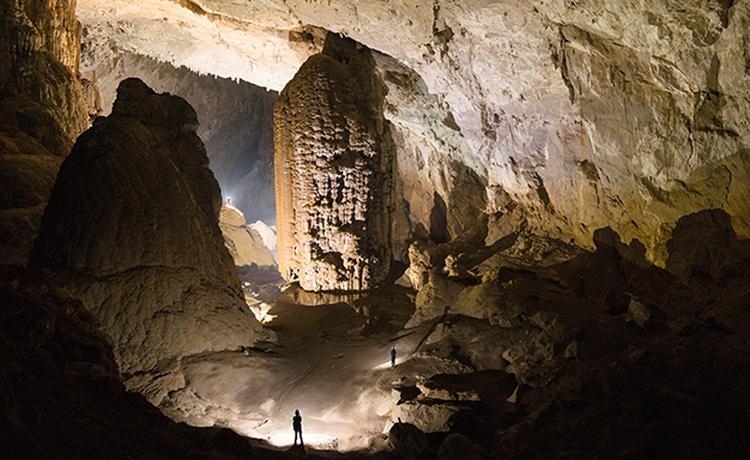
The scale of Son Doong is difficult to comprehend from photographs alone.
The cave is more than 9 kilometers long, while some sections reach approximately 200 meters high and 150 meters wide. Its enormous volume is what gives Son Doong its reputation as the world’s largest cave.
To understand its scale, imagine standing inside a cavern large enough to accommodate a skyscraper.
Now imagine that this cavern is hidden beneath a Vietnamese jungle.
That’s Son Doong.
The photographs often look unreal because the cave is simply too large for the human brain to easily process.
A person standing beside one of its massive stalagmites can look tiny.
An expedition group walking through one of the chambers can appear like a collection of miniature figures.
Entering a Hidden Underground World
Reaching Son Doong is an adventure in itself.
The expedition begins in the jungle, where travelers trek through rugged terrain before reaching the cave entrance.
The entrance is enormous but partially hidden by vegetation and surrounding limestone formations.
As you approach, the temperature changes.
The sound of the jungle begins to fade.
Cool air flows from the cave.
Then you step inside.
The darkness becomes deeper with every step.
After your eyes adjust, the scale of the chamber slowly becomes visible.
At first, you may think you’re looking at a normal cave.
Then you realize that the ceiling is hundreds of meters above you.
That moment is difficult to describe.
Hiking Through Son Doong Cave
Exploring Son Doong requires much more than walking around an underground attraction.
The expedition involves trekking through jungle, climbing over rocks, crossing underground rivers, navigating cave passages, and dealing with steep and uneven terrain.
You may spend hours walking through darkness with only your headlamp illuminating the path ahead.
There are sections where the route follows an underground river.
Elsewhere, massive boulders create challenging climbs.
The environment constantly changes.
One moment you’re walking beside a river.
A few minutes later, you’re climbing through a gigantic chamber filled with unusual rock formations.
The physical challenge is part of the experience.
Son Doong is not designed to be easy.
And perhaps that’s why reaching each major viewpoint feels so rewarding.
Discovering the Underground Jungle
One of the most astonishing features of Son Doong is that plants grow deep inside the cave.
This is possible because enormous collapses in the cave roof created openings known as dolines.
Through these openings, sunlight enters the underground environment.
Over time, vegetation developed in these areas, creating what looks like a miniature rainforest inside the cave.
Standing beneath the enormous roof of Son Doong while surrounded by trees is an almost surreal experience.
It doesn’t look like a typical cave anymore.
It looks like another world.
Sunlight streams through the opening above, illuminating vegetation far below.
Mist may float through the chamber.
The contrast between darkness and sunlight creates some of the most spectacular scenery in Vietnam.
The Underground River


Water has played a crucial role in creating Son Doong.
An underground river runs through the cave system, continuing the geological processes that have shaped the limestone over enormous periods of time.
For explorers, following the river creates a powerful sense of adventure.
The sound of flowing water echoes through the chambers.
Sometimes the river is calm and shallow.
In other areas, the terrain becomes more challenging.
The combination of water, rock, darkness, and enormous open spaces makes the experience feel more like an expedition into an unexplored planet than a conventional cave tour.
Giant Stalagmites and Strange Rock Formations


Son Doong is also home to spectacular geological formations.
Over thousands or millions of years, water slowly dissolved and reshaped the limestone.
The result is a collection of stalactites, stalagmites, cave pearls, and other formations.
Some are enormous.
One of the cave’s famous formations is known as the Hand of Dog, a striking rock structure that has become one of Son Doong’s most recognizable landmarks.
Standing beneath these formations provides a reminder of just how slowly nature can work.
What looks like a giant sculpture was not created by an artist.
It was created by water, limestone, time, and geological forces.
A Cave With Its Own Weather
Perhaps the strangest feature of Son Doong is its microclimate.
Because the cave is so enormous, clouds and mist can form inside some sections.
As warm and cool air interact, moisture can condense within the enormous chambers.
This means that while exploring Son Doong, you might actually see clouds floating beneath the cave roof.
It is one of those moments that makes visitors question whether they’re really underground.
The combination of sunlight entering through the dolines, mist drifting through the chamber, and enormous limestone walls creates an atmosphere unlike almost anywhere else.
Wildlife Inside Son Doong
The cave environment also supports specialized forms of life.
Some organisms have adapted to the darkness and unique conditions of the underground ecosystem.
Cave environments can contain species that are rarely seen elsewhere, including insects, spiders, fish, and other small organisms.
Not every traveler will see unusual wildlife during an expedition.
That’s part of what makes the experience interesting.
The focus isn’t simply on checking off a list of animals.
Instead, you’re exploring an ecosystem that has developed under conditions completely different from those on the surface.
Why Son Doong Is Not an Ordinary Tourist Attraction
Unlike many famous attractions, Son Doong has deliberately avoided mass tourism.
Access to the cave is strictly controlled, with a limited number of expedition participants each year.
The multi-day expedition is operated by specialized tour companies in cooperation with local authorities and park management.
This limited access helps protect the fragile cave environment.
It also means that visiting Son Doong is not as simple as buying a ticket and showing up.
You need to plan well in advance, meet physical requirements, and join an authorized expedition.
For many travelers, this exclusivity is part of the appeal.
You’re not simply visiting a popular attraction.
You’re joining a carefully managed expedition into an extraordinary natural environment.
How Difficult Is the Son Doong Expedition?
A Son Doong expedition requires a good level of physical fitness.
Travelers should be comfortable with long days of walking over uneven terrain, steep climbs and descents, rock scrambling, and river crossings.
You should also be prepared for heat and humidity in the jungle before entering the cave, followed by cooler conditions underground.
This is not the right adventure for someone looking for a relaxed sightseeing holiday.
But for hikers and adventure travelers, the physical challenge adds meaning to the journey.
Every difficult climb leads somewhere extraordinary.
Every muddy trail brings you closer to an environment that very few people have ever seen.
Camping Inside Son Doong


One of the most unforgettable parts of the expedition is camping inside the cave.
Imagine waking up in complete darkness inside one of the largest natural chambers on Earth.
Your tent sits beneath a ceiling that disappears into the shadows.
Nearby, an underground river continues flowing.
Far above, sunlight may enter through a distant opening.
There are no city lights.
No traffic.
No buildings.
Just the sound of nature.
Sleeping inside Son Doong transforms the cave from a sightseeing destination into a genuine expedition environment.
It’s difficult to imagine a more unusual place to spend the night in Vietnam.
The Journey Through Phong Nha-Ke Bang
Although Son Doong is the main attraction, the surrounding Phong Nha-Ke Bang National Park is an adventure destination in its own right.
The park contains an enormous network of caves and underground rivers, along with ancient limestone forests and spectacular mountain landscapes.
Travelers can explore other caves, hike through the jungle, kayak on rivers, cycle through rural villages, or simply enjoy the peaceful countryside around Phong Nha.
This makes it possible to turn a Son Doong expedition into a longer adventure through central Vietnam.
When Is the Best Time to Explore Son Doong?
The timing of a Son Doong expedition is important because weather conditions can affect access and safety.
Expeditions are generally scheduled during a specific season when conditions are considered suitable for exploring the cave.
Heavy rain can increase water levels and make parts of the route more difficult or unsafe.
Because availability and operating dates can change, travelers should check the current expedition schedule with the authorized operator before planning flights and accommodation.
This is one trip where flexibility can be important.
Responsible Tourism in Son Doong
A place as fragile as Son Doong requires responsible tourism.
The cave took an extraordinary amount of time to form, but some of its formations can be damaged in seconds.
Travelers should therefore:
- Never touch cave formations.
- Stay on designated routes.
- Follow the expedition guide’s instructions.
- Avoid leaving any waste behind.
- Never remove rocks, fossils, or other natural objects.
- Respect wildlife.
- Avoid unnecessary noise.
- Follow all conservation regulations.
The goal is simple:
Explore the cave without changing it.
Every visitor has a responsibility to help ensure that future generations can experience the same extraordinary landscape.
What to Pack for Son Doong
Because the expedition takes place in a remote environment, packing appropriately is essential.
Your tour operator will normally provide or specify much of the required equipment, but personal items may include:
- Lightweight, quick-drying clothes
- Sturdy hiking shoes
- Extra socks
- Waterproof bags
- Small personal backpack
- Headlamp
- Reusable water bottle
- Insect repellent
- Sunscreen
- Personal toiletries
- Camera
- Spare batteries or power bank
- Basic personal medication
Don’t overpack.
You’ll be carrying your personal belongings through challenging terrain, so lightweight equipment is always preferable.
Why Exploring Son Doong Is a Once-in-a-Lifetime Experience
There are plenty of spectacular caves around the world.
But Son Doong feels different.
It is not simply large.
It contains an entire underground landscape.
There are rivers.
Forests.
Clouds.
Mountains of rock.
Unique ecosystems.
And chambers so enormous that humans appear almost invisible inside them.
The experience also requires effort.
You have to trek through the jungle.
You have to climb.
You have to get wet.
You have to sleep underground.
And you have to leave the comforts of ordinary tourism behind.
That combination of adventure, isolation, geology, and natural beauty is what makes Son Doong so special.
Final Thoughts
Exploring Son Doong Cave in Vietnam is far more than visiting a famous natural attraction.
It is an expedition into a hidden world beneath the Vietnamese jungle.
From the first steps through the enormous entrance to crossing underground rivers, walking beneath towering limestone formations, discovering forests growing inside the cave, and camping beneath an underground sky, every stage of the journey feels extraordinary.
Son Doong demonstrates just how much of our planet remains mysterious.
And perhaps the most remarkable part is that this incredible world is not located on another planet.
It is here in Vietnam.
Hidden beneath the forests of Phong Nha.
Waiting for those willing to walk deep enough to discover it.
If you are searching for one of the world’s most extraordinary adventure travel experiences, Son Doong belongs on your bucket list.
Leave a Reply